- Home
- For Patients
- 1.What causes inherited GPI deficiency (IGD)?

Q1.What causes inherited GPI deficiency (IGD)?
A1.Human tissues—such as the brain, heart, muscles, fat, and skin—are composed of tissue-specific cells. In these cells, more than 10,000 types of proteins are produced from genes (the body’s “blueprints”) via RNA. Proteins are distributed throughout the cell, including the nucleus (which contains the genes), organelles such as mitochondria, the cytoplasm, and the cell membrane, where they perform essential functions. Among the proteins present on the cell membrane, there is a group sharing a common structure called GPI-anchored proteins. More than 150 GPI-anchored proteins have been identified, including enzymes such as alkaline phosphatase (ALP), and they play important roles. A GPI anchor is a glycolipid used to attach these proteins to the cell membrane. Inside the cell, the anchor portion and the protein portion are synthesized separately, then joined together and function on the cell surface. It is known that 30 genes are required for the synthesis and remodeling of the GPI anchor. If GPI anchors are absent due to abnormalities in these genes, more than 150 GPI-anchored proteins cannot be expressed on the cell surface; therefore, complete deficiency is not compatible with life. Inherited GPI deficiency is caused by a variant in one of these 30 genes that reduces enzyme activity, leading to decreased levels of GPI-anchored proteins on the cell surface or structural abnormalities, resulting in disease onset.
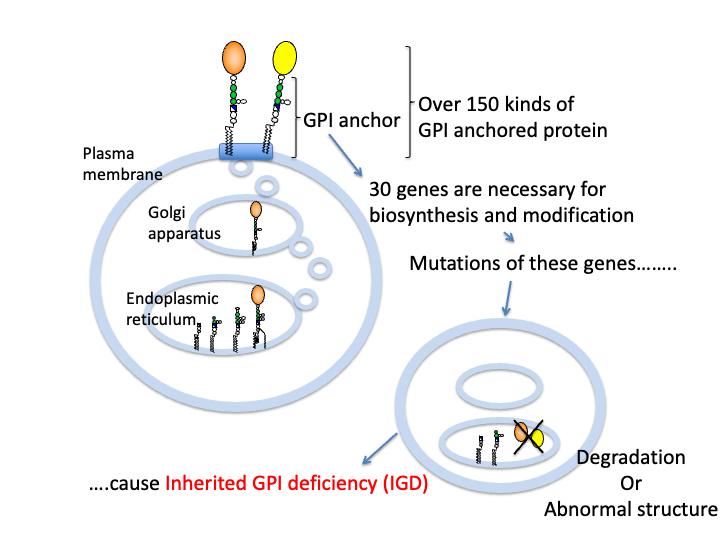
GPI-anchored proteins are synthesized in the endoplasmic reticulum (ER) through multiple complex steps. The genes involved in the steps of GPI-anchor biosynthesis in the ER are called PIG genes, designated PIGA through PIGZ. Afterward, the proteins undergo various modifications in the ER and Golgi apparatus and are transported to the cell surface. The genes involved in these remodeling steps are called PGAP genes, from PGAP1 to PGAP5. Disorders caused by variants in any of these 30 genes are referred to as inherited GPI deficiency (IGD). Because complete loss of GPI biosynthesis is lethal in utero, most patients have partial deficiencies with reduced activity. To date, IGD due to variants in 24 of the 30 genes has been reported.