
An in vivo fitness gene of Toxoplasma, MIC11, is essential for PLP1-mediated egress from host cells (Yamamoto Lab, in Nat Commun)
After invasion and replication, intracellular pathogens must egress from infected host cells. Toxoplasma gondii facilitates this process by permeabilizing host cells through induced secretion of perforin-like protein 1 (PLP1). However, the precise mechanism of host cell permeabilization remains enigmatic. Here, we identify the secretory microneme protein MIC11 as a key factor for membrane disruption. A CRISPR-based in vivo screen identifies MIC11 as the top in vivo fitness-conferring gene. Deletion of MIC11 results in severe defects in membrane rupture and egress. Scanning mutagenesis identifies functional motifs in MIC11, and mechanistic analyses support an association between MIC11 and PLP1, suggesting that MIC11 is involved in PLP1-dependent membrane disruption. Moreover, the merozoite-specific paralogue MIC22 functionally complements MIC11 deletion, suggesting a conserved mechanism of egress in the feline-restricted stages of T. gondii. Collectively, the discovery of MIC11 advances our understanding of how parasites disrupt host cells to facilitate rapid egress and successful dissemination.
Links
-
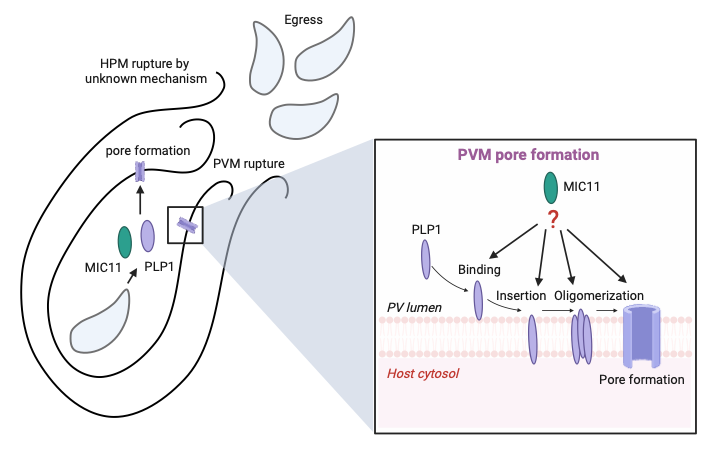
Revised model membrane pore formation and egress
- Home
- Achievement
- Research Activities
- An in vivo fitness gene of Toxoplasma, MIC11, is essential for PLP1-mediated egress from host cells (Yamamoto Lab, in Nat Commun)