
Inflammatory mediators of mRNA vaccine-induced adverse reactions in mice (Yoshioka Lab, Mol Ther)
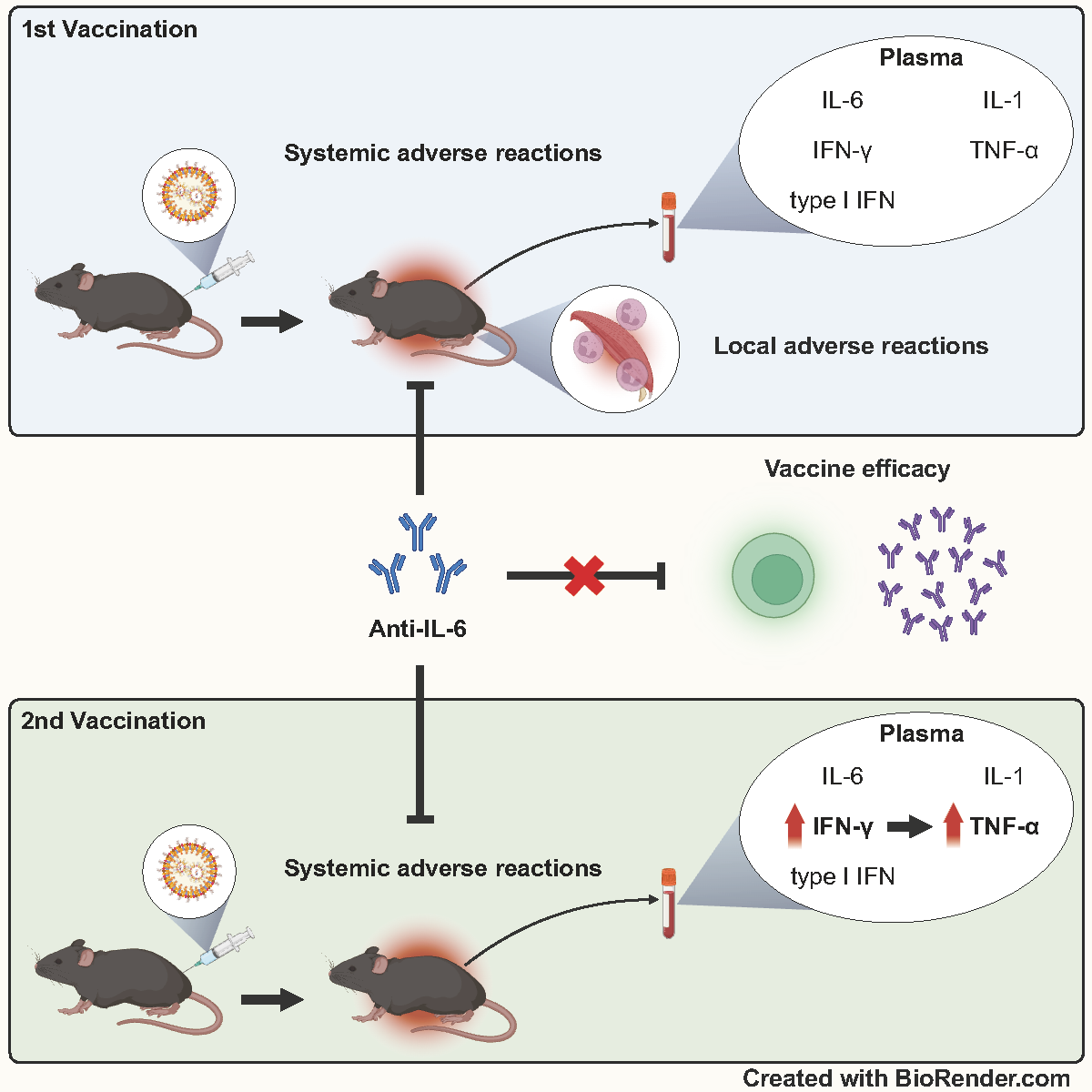
mRNA vaccines are promising vaccine modalities against infectious diseases. However, these vaccines frequently cause adverse reactions, such as fever and fatigue, which are exacerbated after a booster dose, leading to vaccine hesitancy. Here, we elucidated the mechanisms underlying adverse reactions in mice after prime and boost vaccinations with mRNA vaccines. The mRNA vaccine induced systemic adverse reactions, such as fever, and local adverse reactions, such as enhanced vascular permeability, at the vaccination site in mice. Lipid nanoparticles (LNPs) used for mRNA encapsulation mainly contributed to these adverse reactions. We identified IL-1, IL-6, TNF-α, and type 1 IFN as key cytokines and COX-2 and PGE2 as inflammatory mediators responsible for systemic adverse reactions. TNF-α levels were enhanced after the boost vaccination by IFN-γ secreted from prime-vaccination-induced T cells, contributing to systemic adverse reactions. In addition, local adverse reactions at the vaccination site were caused by a mechanism different from that of systemic adverse reactions. We also found that the inhibition of IL-6 effectively reduced the adverse reactions while maintaining the vaccine effects. These data provide basic information for understanding adverse reactions in humans and may be useful for developing mRNA vaccines with fewer adverse reactions.
This Article was published in Molecular Therapy on January 20, 2026.
Title: Inflammatory mediators of mRNA vaccine-induced adverse reactions in mice
Auhtors: Koyo Honda, Tatsuya Karaki, Yuta Kunishima, Yoshino Kawaguchi, Naoki Takemura, Takashi Matsuzaki, So-ichiro Fukada, Tatsuya Saitoh, Toshiro Hirai, Yasuo Yoshioka
DOI: 10.1016/j.ymthe.2026.01.022.
Links
- Home
- Achievement
- Research Activities
- Inflammatory mediators of mRNA vaccine-induced adverse reactions in mice (Yoshioka Lab, Mol Ther)