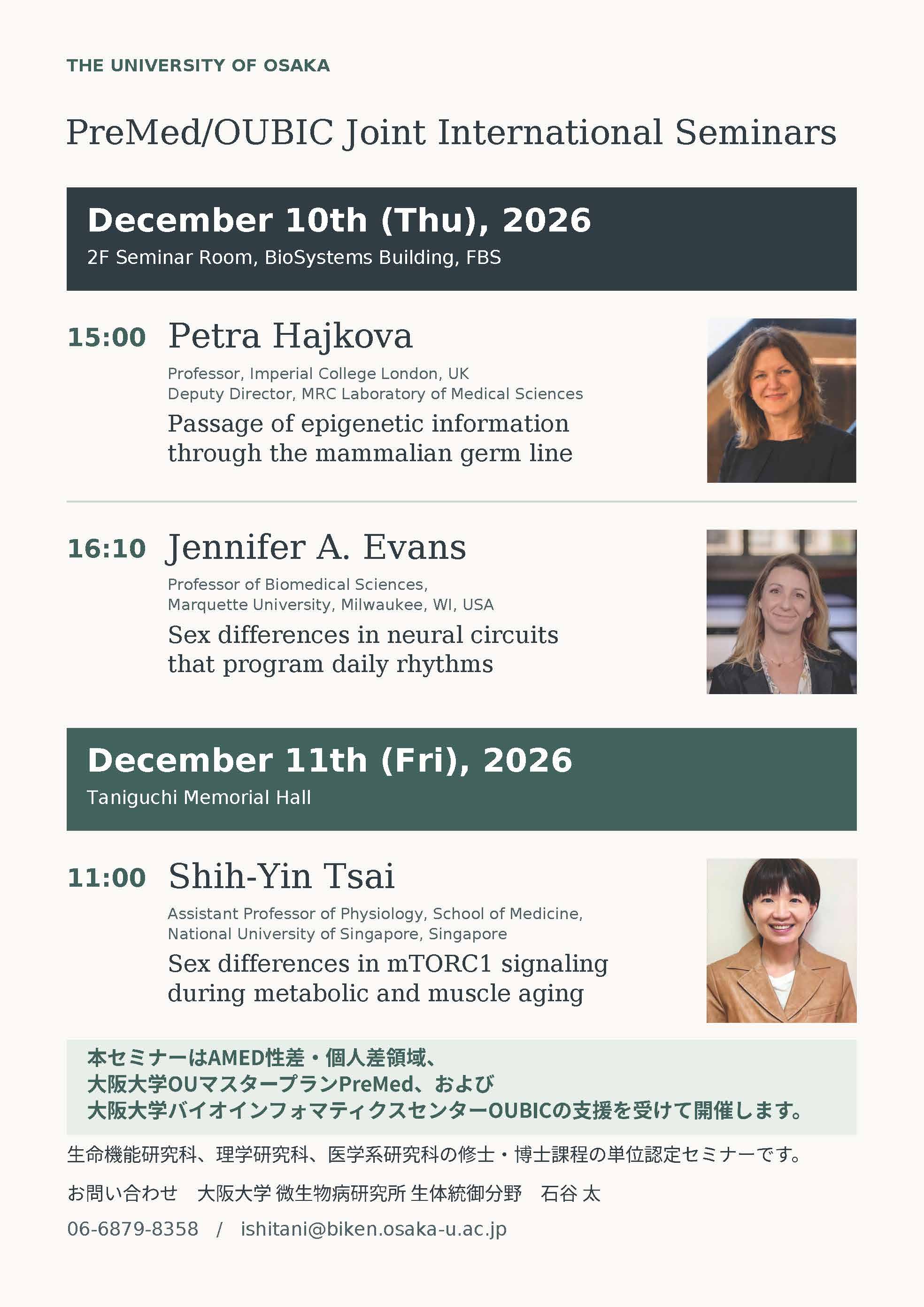
12月10日(木)・11日(金)に、PreMed/OUBiC Joint International Seminarsを開催します。
発生エピジェネティクス、概日時計、代謝・筋老化の分野で国際的に活躍する3名の女性研究者を吹田キャンパスにお招きし、それぞれの最新の研究成果をお話しいただきます。
| 15:00 - |
演者
Prof. Petra Hajkova
(Professor, Imperial College London, UK
Deputy Director, MRC Laboratory of Medical Sciences)
演題
Passage of epigenetic information through the mammalian germ line
概要
Using mouse embryonic development as an experimental model, our long term interest is how epigenetic information is propagated during development and erased in the context of the germ line (zygotic and germline reprogramming). My laboratory has contributed fundamental insights regarding the mechanisms of global DNA demethylation, the connection to chromatin remodelling and the role of Tet enzymes in both zygotic and germline reprogramming events (Amouroux et al, Nat Cell Biol 2016, Hill et al, Nature 2018, Huang et al, Nature 2021, Huang et al, NSMB 2026). Stability and maintenance of the epigenetic profile underpins the stability of cell fate. This is particularly pertinent in the case of long-lived post-mitotic cells, such as neurons or oocytes. Although our previous research was predominantly focused on developmental reprogramming (ie erasure of epigenetic information) we have become increasingly interested in the stability of epigenetic information across time scale. I will present our latest results addressing stability and turnover of DNA modifications in cultured cells and contrast this with our findings in the context of developmental epigenetic reprogramming. I will also discuss the stability of epigenetic information in the context of oocytes with profound implications for female age-related fertility decline.
|
| 16:10 - |
演者
Prof. Jennifer A. Evans
(Professor, Biomedical Sciences, Marquette University, Milwaukee, WI, USA)
演題
Sex differences in neural circuits that program daily rhythms
概要
Daily rhythms in behavior and physiology facilitate adaptive homeostasis by aligning internal physiology with local conditions. Photic entrainment of circadian rhythms requires daily resetting of the central clock in the suprachiasmatic nucleus (SCN). Retinal and intracellular mechanisms that induce SCN resetting are well established; however, it remains unclear how SCN neurons process photic cues as an integrated and heterogeneous timekeeping network. To better understand the kinetics of SCN photic processing at the network level, here we monitor SCN responses to photic stimulation in real time using ex vivo 2-photon imaging. Aligned with previous work, baseline levels of GCaMP6s were higher in SCN neurons during the day and overall SCN responses to photic stimulation was larger at night, thus confirming both daily rhythms are preserved ex vivo. Notably, we find that cellular responses to photic stimulation varied among SCN neurons located in different subdomains of the network. Interestingly, network-level patterning of photic processing was stereotyped across biological replicates and independent of time of day. Using optogenetic and pharmacological approaches, we show that spatial gating of cellular sensitivity is driven by both pre- and post-synaptic mechanisms. Further, we define NMDAR circuits that contribute to heterogeneity in cellular sensitivity, which differ by biological sex. This work provides new insight into the functional architecture of central circadian circuits that process light. Continued work focused on defining SCN visual circuits can ultimately inform how bright light during the day provides health benefits whereas mistimed light at night increases disease vulnerability.
|
| 11:00 - |
演者
Dr. Shih-Yin Tsai
(Assistant Professor of Physiology, School of Medicine,National University of Singapore, Singapore)
演題
Sex differences in mTORC1 signaling during metabolic and muscle aging.
概要
Female advantage in longevity has been observed across years and countries, yet the molecular basis of this female longevity advantage remains poorly understood. In addition to sex hormones, sex differences in tissue metabolism and nutrient signaling are increasingly recognized as contributors, but how nutrient-sensing pathways shape sex-specific aging is unclear. In this talk, I will first describe our finding that mTORC1 signaling is differentially regulated in male and female tissue during metabolic stress and aging. Using genetically modified mice, I will then show that the two major mTORC1 effectors, 4E-BP1 and S6K1, mediate distinct, sex-dependent effects on muscle homeostasis and systemic metabolism. Finally, I will present new data revealing sex differences at the organelle level in muscle. Together, these studies suggest that differential engagement of mTORC1 effectors underlies sex-specific trajectories of metabolic and muscle aging. Understanding these mechanisms may guide sex-informed strategies that target selected mTORC1 effectors, rather than mTORC1 itself, to promote healthy aging while limiting off-target effects.
|
本セミナーはAMED性差・個人差領域、大阪大学OUマスタープランPreMed、および大阪大学バイオインフォマティクスセンターOUBICの支援を受けて開催します。
※本セミナーは英語で開催します。
※医学系研究科、生命機能研究科、理学研究科の修士・博士課程の単位認定セミナーです。
※世話人:石谷 太(生体統御分野 8358, ishitani*biken-osaka-u.ac.jp)
(メールアドレスは「*」を半角「@」に変更してください)
世話人からのコメント:
Hajkova先生は、哺乳類の生殖細胞や受精卵で起こる大規模なDNA脱メチル化の仕組みを解き明かしてきた、発生エピジェネティクスの第一人者です。今回は、その「消去」の研究から、エピジェネティックな情報が長期にわたってどう保たれるかという問いまでお話しいただきます。
Evans先生は、脳の視交叉上核にある体内時計を、性質の異なる神経細胞のネットワークとして研究しています。今回は、二光子イメージングで神経細胞の光刺激への応答をリアルタイムに捉え、光の情報が回路のどこで、どう処理されるのかを紹介していただきます。光への感受性を調節する神経回路に見られる性差も、今回の見どころです。
Tsai先生は、骨格筋の加齢変化を、タンパク質恒常性と代謝の両面から研究しています。今回は、遺伝子改変マウスを用いて、mTORC1の下流にある4E-BP1とS6K1が、筋肉の維持と全身の代謝に雌雄で異なる影響を及ぼすことを紹介していただきます。筋細胞内のオルガネラに見られる性差から、性差を考慮した老化介入の可能性まで議論が広がります。