
TCR-like antibodies regulate T cell responses (Arase Lab, in Nat Commun)
Antigen-specific regulation of T cell response is crucial for limiting hyperimmune response. However, the molecular mechanisms governing specific immune regulation remain unclear. In this study, we discover that antibodies specific to the antigen peptide-MHC class II complex are produced during helper T cell responses to various antigens, including hen egg lysozyme and proteolipid protein peptide. These antibodies specifically inhibit T cell receptor (TCR) recognition of MHC class II molecules presenting specific antigen peptide. We term these antibodies ‘immune-induced TCR-like antibodies’ or iTabs. Immunization with peptides containing flanking residues induces iTabs whereas immunization with peptides lacking flanking residues does not. Furthermore, we show that immunization with iTab-inducible peptide or iTab treatment suppress autoimmune disease development in a mouse model of experimental autoimmune encephalomyelitis. Thus, our findings provide a strategy for suppressing antigen-specific helper T cell responses using specific peptides, potentially controlling autoimmune diseases.
This article was published in Nature Communications on April 16, 2026.
Title: “Immune-induced TCR-like antibodies regulate specific T cell response in mice”
Authors: Kazuki Kishida, Keisuke Kawakami, Hiroaki Tanabe, Wataru Nakai, Koji Yonekura, Shigeyuki Yokoyama, Hisashi Arase
Links
-
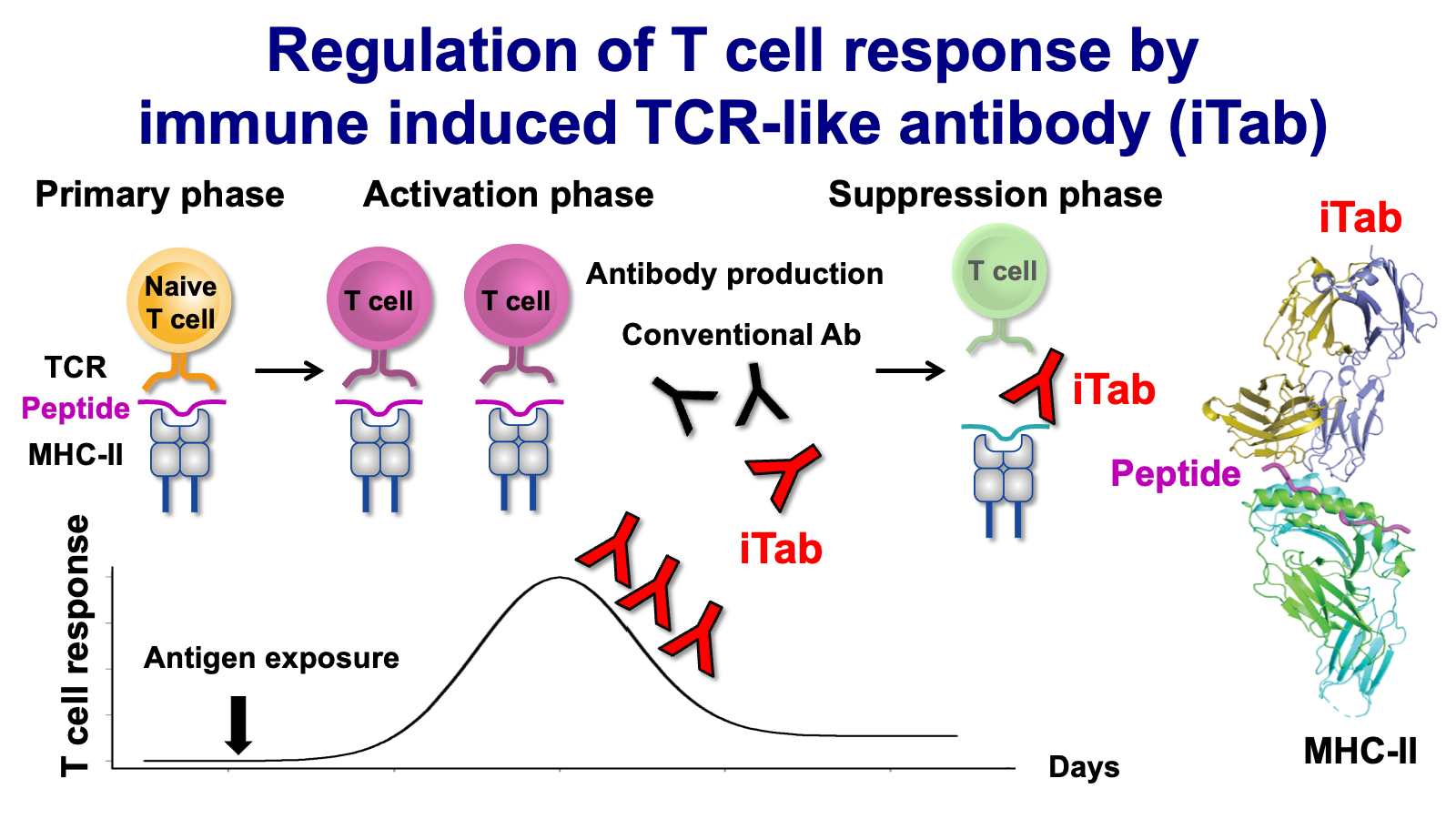
We found that T cell receptor-like antibodies are produced during antigen-induced immune responses, thereby suppressing the immune response mediated by antigen-specific T cells.
- Home
- Achievement
- Research Activities
- TCR-like antibodies regulate T cell responses (Arase Lab, in Nat Commun)