
Mycobacterial α-glucans hijack Dectin-1 to facilitate intracellular bacterial survival (Yamasaki Lab, in Science Immunology)
Mycobacteria have a cell envelope that can act as a shield against host defense. This study shows that mycobacteria survive in host macrophages by targeting the innate host receptor Dectin-1 through a noncanonical ligand. Compared with wild-type (WT) mice, Dectin-1–deficient mice were more resistant to infection to mycobacteria. Dectin-1–deficient mice presented with substantially reduced bacterial burdens, inflammatory cytokines, and infiltrating myeloid cells, such as neutrophils and macrophages.
Intracellular survival of these bacteria was reduced in macrophages derived from Dectin-1–deficient mice compared with those from WT mice. Cellular characterization of mycobacterial infected macrophages indicated that the presence of Dectin-1 altered phagosomal maturation and association with markers of autophagy. Activity-based purification and nuclear magnetic resonance spectrometry identified branchedα-glucan as the Dectin-1 mycobacterial ligand. This branched glucan was essential for activating Dectin-1. These results show that mycobacterial α-glucan targets Dectin-1 to facilitate intracellular bacterial survival.
This article was published in Science Immunology on January 9, 2026.
Title: “Mycobacterial α-glucans hijack Dectin-1 to facilitate intracellular bacterial survival”
Authors: Shota Torigoe, Sumayah Salie, Roanne Keeton, Beren Aylan, Ben J. Appelmelk, David L. Williams, Douglas W. Lowman, Toshihiko Sugiki, Sohkichi Matsumoto, Akira Kawano, Satoru Mizuno, Kazuhiro Matsuo, Jonas N. Søndergaard, James B. Wing, Maxine Hoft, Romey Shoesmith, Mthawelanga Ndengane, Anna K. Coussens, Janet A. Willment, Maximiliano G. Gutierrez, Jennifer Claire Hoving, *Sho Yamasaki and *Gordon D. Brown
*Corresponding Author
Links
-
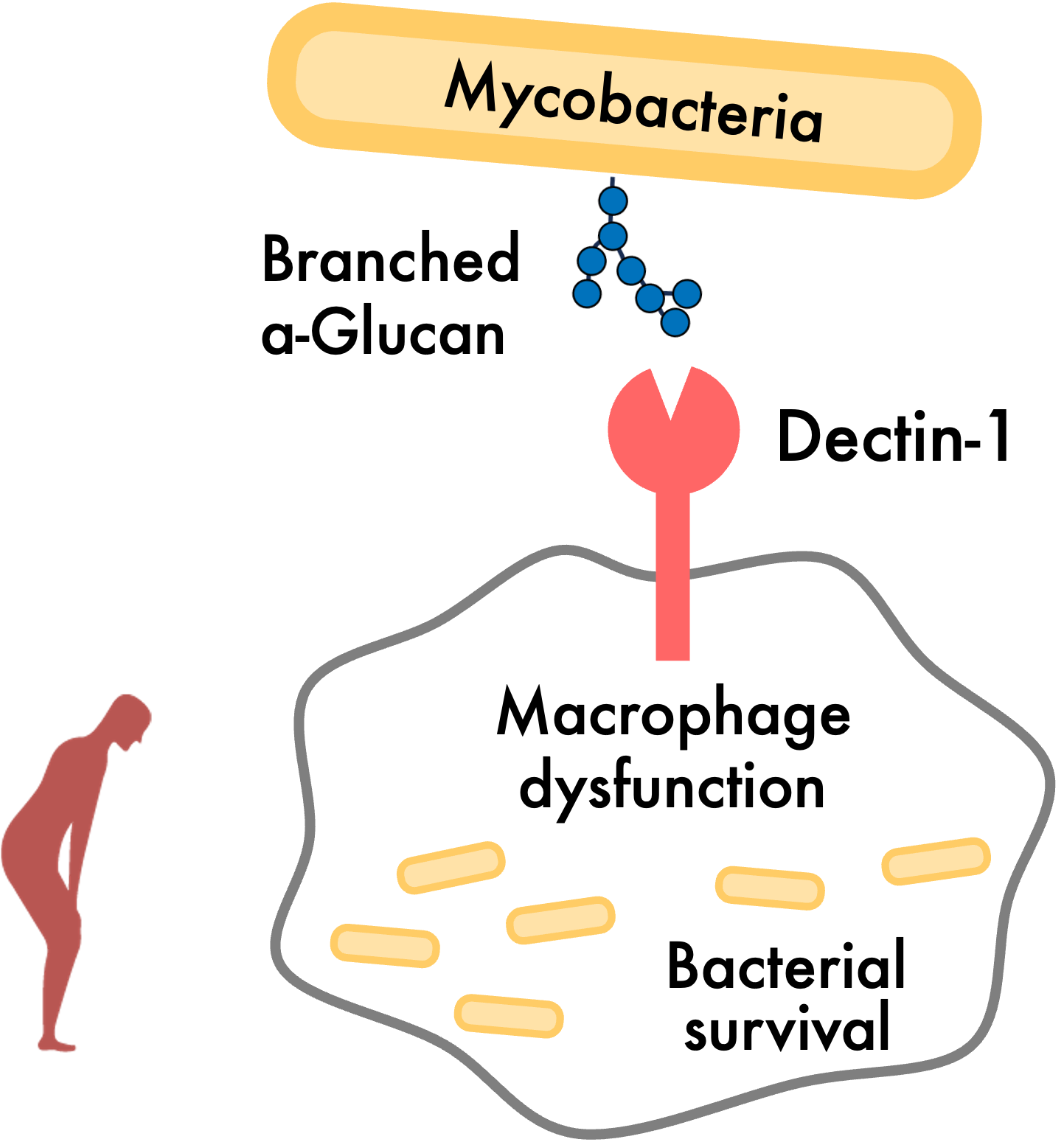
Figure) Branched a-Glucan of mycobacteria suppresses macrophage function through Dectin-1 and promotes bacterial survival
- Home
- Achievement
- Research Activities
- Mycobacterial α-glucans hijack Dectin-1 to facilitate intracellular bacterial survival (Yamasaki Lab, in Science Immunology)