
Dev Cell. 33(3):247-59 2015/05/04
In adult peripheral tissues, alignment of arteries, veins and nerves is visible anatomically and is considered to have some physiological function. Intimate associations and functional interactions between nerve and artery are now well-established, but the mechanisms that determine the alignment of veins and arteries have not been elucidated.
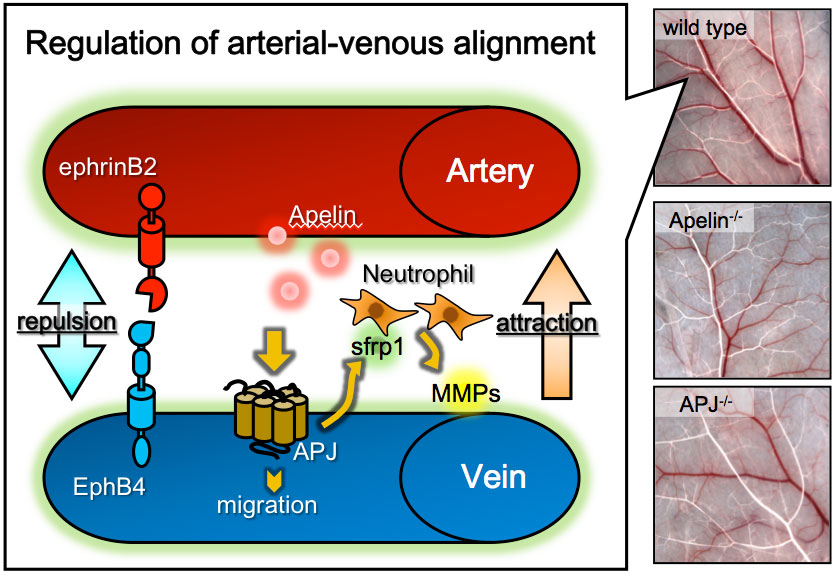
Arteries and veins were distinguished by their morphological appearance and molecular differences. Repulsive effect between arterial-specific EphrinB2 and venous-specific EphB4 is a major mechanism to maintain distance between arteries and veins; however, maintenance of the parallel juxtaposition of arteries and veins cannot be explained simply by repulsion. Here we report that arterial-venous alignment in the skin is determined by apelin receptor (APJ) expression in venous ECs. We found that apelin is produced by arterial ECs during embryogenesis, induces chemotaxis of venous ECs, and promotes the production of sFRP1 by APJ postive ECs. sFRP1 stimulates matrix metalloproteinase production by neutrophil-like cells located between the arteries and veins, resulting in remodeling of extracellular matrices to support venous displacement. Moreover, using apelin- or APJ-deficient mice, which exhibit arterial-venous disorganization, we found that arterial-venous alignment is involved in thermoregulation, possibly by regulating countercurrent heat exchange. We hypothesize that the evolution of parallel juxtapositional arterial-venous alignment was an adaptation to reduce body heat loss.
Links
- Home
- Achievement
- Research Activities
- Dev Cell. 33(3):247-59 2015/05/04