
Proc. Natl. Acad. Sci. U S A 112(37):11612-11617 2015/08/24
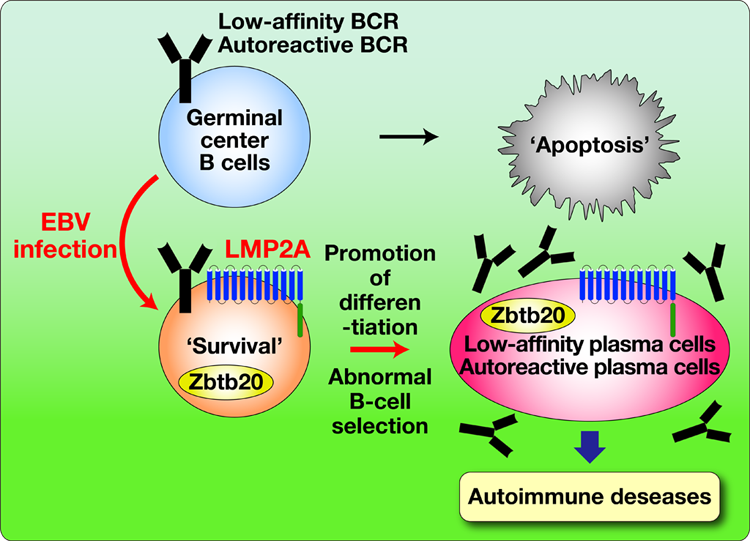
Epstein–Barr virus (EBV) is a human herpesvirus which establishes latency in B cells. EBV is a causative agent of infectious mononucleosis and associated with autoimmune diseases, such as systemic lupus erythematosus (SLE) and multiple sclerosis (MS). However, it remains unclear how EBV contributes to autoimmunity. In this study, we generated a mouse model where germinal center (GC) B cells express EBV-encoded latent membrane protein 2A (LMP2A) mimicking B-cell receptor signaling, and analyzed the impact of LMP2A expression in GC B cells. These mice showed signature of SLE, including autoantibody production and immune complex deposition in kidney. In addition, LMP2A not only reduced affinity of BCR by impaired B cell selection but also upregulated the transcription factor zinc finger and bric-a-brac, tramtrack domain-containing protein 20 (Zbtb20) and promoted plasma cell differentiation. Our findings suggest that LMP2A has important roles in B-cell activation and differentiation and in the development of EBV-associated autoimmune diseases.
Links
- Home
- Achievement
- Research Activities
- Proc. Natl. Acad. Sci. U S A 112(37):11612-11617 2015/08/24