
11/16 RIMD Seminar: Dr. Spyros Lytras & Dr. Liam Brierley
October 15, 2026
Events and Seminars
|
Date |
Nov. 16 (Mon.)16:00-
|
|---|---|
| Venue |
BikenHall, Main building 1F, Research Institute for Microbial Diseases (RIMD) |
| 16:00~16:30 |
Speaker Spyros Lytras(Antigen Evolution and Design Laboratory, Department of Structural Biology and Chemistry, Institut Pasteur) Title Leveraging structural predictions to understand virus glycoprotein evolution on the macro and micro-scale Abstract Viral glycoproteins mediate membrane fusion, dictate host range and facilitate virus immune evasion. The proteins’ important roles paired with the fast evolutionary rate of viruses lead to rapid accumulation of changes in their sequences, hindering homology detection over deep evolutionary time. Recent AI-based methods such as AlphaFold and ESMFold have enabled fast and accurate prediction of protein structures from sequence alone. On the macro-scale, we leverage these structural prediction methods at scale to infer the evolutionary histories of viral glycoproteins based on both sequence but also structural similarity between them. Applied to large virus taxa such as the Flaviviridae and the Coronaviridae, this approach allows us to uncover the wide diversity and complex evolutionary origins of these proteins. On the micro-scale, we can predict co-structures of glycoproteins together with host proteins they are expected to interact with, such as entry receptors. By assessing the prediction confidence of glycoprotein-receptor co-structures for closely related viruses and receptor orthologs we can infer the hosts that each virus strain can infect as well as the interacting residues controlling the ability to infect. These computational predictions are consistent with experimental validation of receptor-based virus infectivity, showcasing the usefulness of structural predictions in assessing the properties of novel viruses. Overall, structural predictions can be instrumental for uncovering both the deep scale evolution of virus glycoproteins, obscured by accumulated diversity, but also the phenotypic effects of even single mutations that disrupt protein-protein structural interactions.
|
| 16:30~17:00 |
Speaker Title Abstract |
※ The lectures will be conducted in English.
※ This is a credit recognition seminar for Master Doctoral Degree Programs of the Graduate School of Medicine.
※ Contact: Prof. Jumpei Ito, Laboratory of Virus Informatics
E-mail: jumpeiito*biken.osaka-u.ac.jp (Please replace * with @)
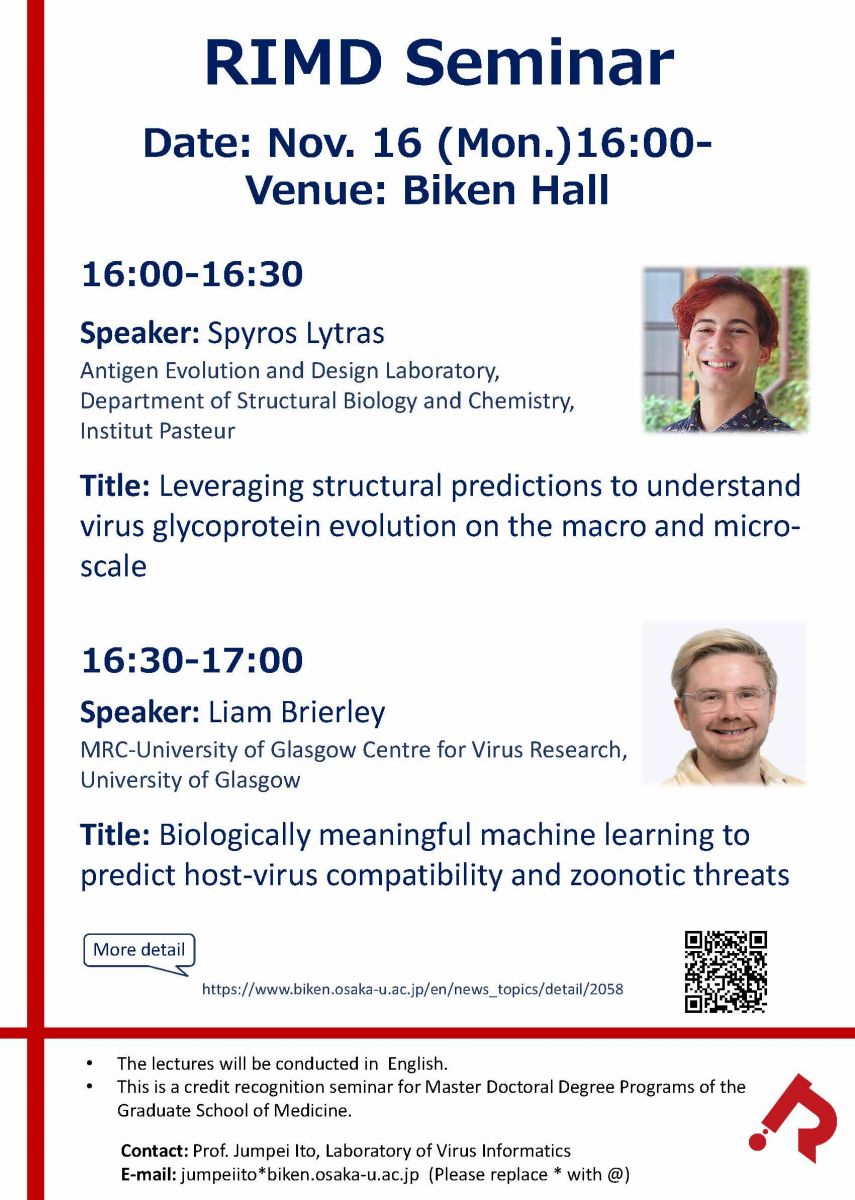
Poster
- Home
- NEWS&TOPICS