The research activities in our department aim to 1) investigate the epidemiology, pathogenesis and prevention by vaccines of pneumonia and invasive bacterial infections, 2) elucidate the mechanisms by which dengue viruses induce disease, and 3) analyze the protein secretion systems of pathogenic bacteria. In addition, our group is registered as a member of the World Health Organization (WHO)/Global Outbreak Alert & Response Network (GOARN) and, when necessary, will join the outbreak response team in the global effort to control emerging and re-emerging infectious diseases.
1) Epidemiology, pathogenesis, and vaccine-mediated prevention of pneumonia and invasive bacterial infections
1. Study of pneumonia in Thailand
We have conducted a study project entitled "Surveillance of emerging respiratory infections and analysis of mechanism of secondary bacterial pneumonia in Thailand". This project allowed us to investigate how virus-host-bacteria interactions promote secondary bacterial infections in pediatric patients with pneumonia. In 2009, we examined the clinical features of 24 adult cases of pandemic H1N1 influenza-associated severe community-acquired pneumonia at Buddachinaraj Hospital, Phitsanulok.
2. Clinical applications of the 23-valent pneumococcal polysaccharide vaccine (PPV) and the development of new pneumococcal vaccines
a) Clinical application of 23-valent PPV
We found that the combined PPV and influenza vaccine (IV) vaccination program reduced the incidence of acute exacerbation in patients with chronic obstructive pulmonary diseases (Vaccine, 2008). An open-label, randomized study was conducted involving 786 Japanese subjects older than 65 years of age who were receiving a routine IV. Concomitant PPV vaccination significantly reduced the number of admissions and medical costs for all-cause pneumonia for subjects older than 75 years. We also started a project in 2008 that examines the effects of PPV in combination with IV on long-term-care residents. Our goal is the nationwide and routine vaccination of the elderly in Japan.
b) Development of a nasal mucosal pneumococcal vaccine
Pneumococcal surface protein A (PspA) is known to elicit protective antibodies in animals. We have demonstrated the effects of PspA plus TLR agonist on bacterial clearance in a mouse model of pneumococcal pneumonia (Vaccine, 2009). In addition, we have shown that the PspA nasal vaccine is effective in a mouse model of secondary pneumonia after influenza virus infection.
3. Research on Streptococcus suis infections, which are prevalent in Thailand
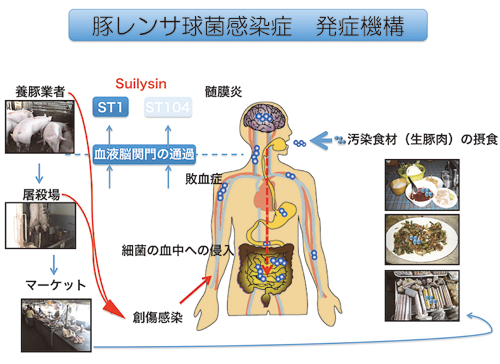
Streptococcus suis is an important zoonotic pathogen that causes invasive infections such as meningitis in humans who are in close contact with infected pigs or contaminated pork-derived products. The number of such human cases is rapidly increasing in Thailand because of a tradition of consuming raw pork or blood in the north. We showed that the clinical manifestations of serotype 2 infections are related to the genotypic profiles of the isolates; we also reported the clonal dissemination in humans of serotype 14, which has been a rarely occurring serotype up until now (Figure 1). We are currently developing an epidemiological study of S. suis infections in Phayao Province as a project of RCC-DMSc.
2) Mechanisms by which dengue virus infections lead to thrombocytopenia
Dengue illness has become a major public health concern, particularly in tropical countries. We have conducted a number of clinical studies in the Philippines and recently found in an exo vivo setting that patients with thrombocytopenia during acute phase secondary dengue virus infections showed increased phagocytosis of platelets (AJTMH, 2009). Since we found that IVIG treatment did not significantly hasten the recovery from thrombocytopenia in such patients (AJTMH, 2007), this suggests that the Fc¦Ã receptor is not involved in platelet phagocytosis by macrophages. We are currently elucidating the novel mechanism by which the platelets are phagocytosed in this disease.
3) Protein secretion systems of pathogenic bacteria
The development of bacterial infections requires many virulence factors. Since most are proteins that are secreted by the pathogenic bacteria, it is essential to study the mechanisms by which proteins are secreted by pathogenic bacteria during the course of infection. We are using the food-borne pathogen Vibrio parahaemolyticus and a causative agent of pneumonia, Streptococcus pneumoniae, to study such protein secretion systems and the secreted virulence factors.
4) Response to emerging and re-emerging infectious diseases
The objective of GOARN is to combat the international spread of infectious disease outbreaks by ensuring that appropriate technical assistance reaches the affected areas rapidly and by promoting long-term epidemic preparedness. Our group is registered as a member of GOARN and our team will join the WHO-organized response team when there is an outbreak of infectious diseases in developing countries.
¡¡Figure 1. Assumed routes of transmission and pathogenesis of S. suis infection, and the clonal dissemination of serotype 14 infections in Thailand (J Med Microbiol, 2009).