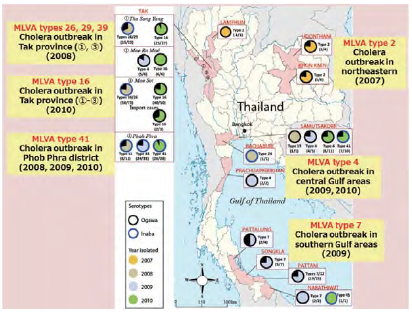
Geographical spread and temporal changes of Vibrio cholerae O1 during the 2007–2010 cholera outbreaks in Thailand. |
In collaboration with the National Institute of Health, Department of Medical Sciences, Ministry of Public Health of Thailand, the Section of Bacterial Infections pays special attention to emerging and reemerging bacterial diseases that are prevalent or break out in Asian countries. We conduct molecular epidemiology studies on enteric or systemic bacterial infections. Moreover, we also develop detection and identification techniques for the diagnosis of bacterial diseases described below.
It is reported that pneumonia, tuberculosis, and acute diarrheal diseases are associated with high morbidity and mortality rates in Thailand. Consequently, in the Program of Promotion of Research Network for Emerging and Reemerging Infectious Diseases during the 2010–2014 fiscal years, we prioritized research on cholera in Thailand and its causative agent, Vibrio cholerae.
In addition, Streptopcoccus suis, which is occasionally pathogenic and frequently isolated from diseased pigs, has been found to cause several systemic (zoonotic) infectious diseases in humans, namely meningitis, infective endocarditis, and toxic shock-like syndrome. This has mainly been observed in Asian countries, including Northern Thailand. We will examine this emerging zoonotic infection closely, and elucidate the molecular pathogenesis of S. suis infections.